

Donalds Dominates Florida’s Republican Primary
Trump’s endorsement, unrivaled name recognition, and a consolidated populist electorate have placed the congressman in a commanding position.

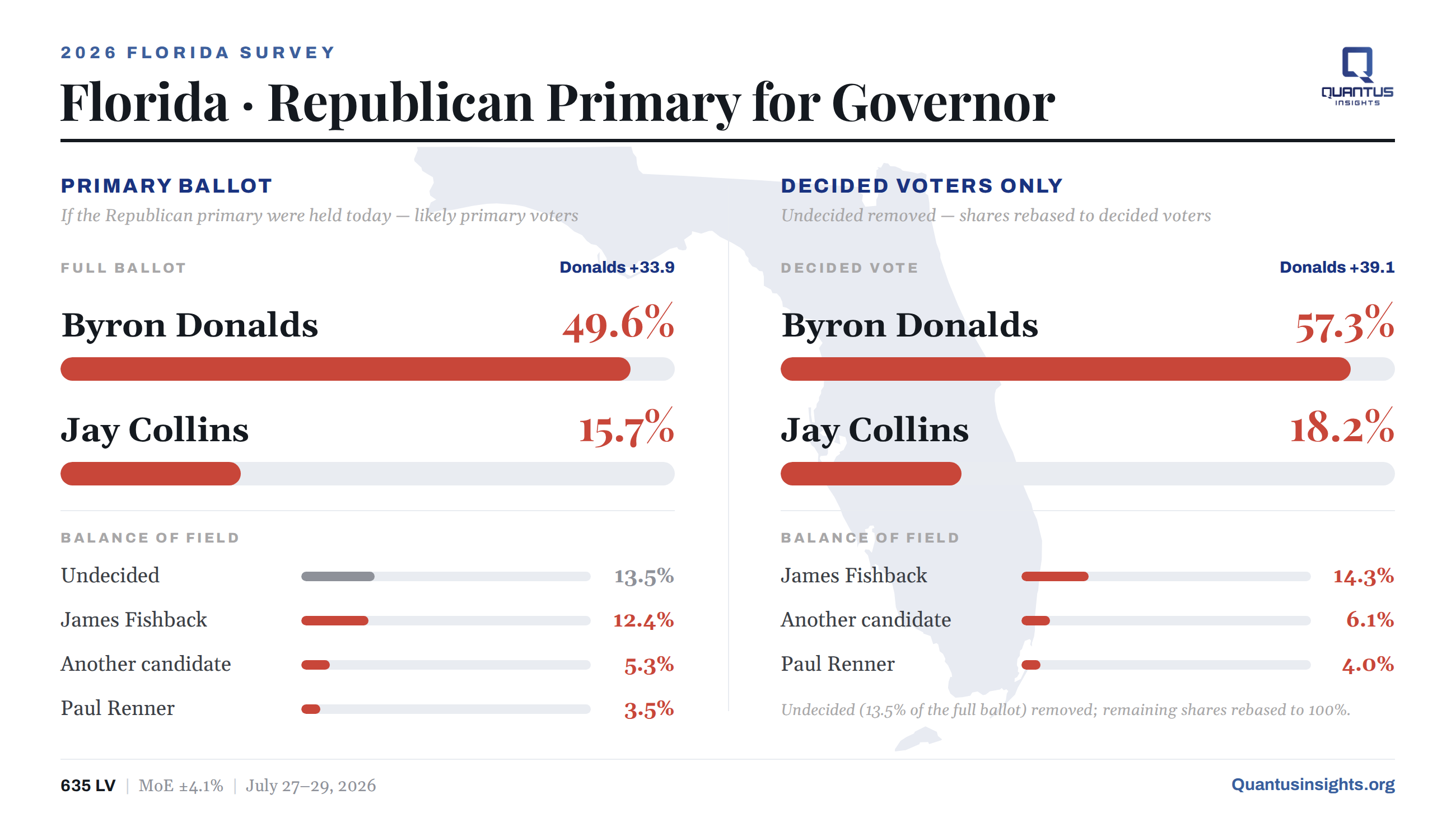
Florida’s Republican primary for governor is, at least for now, less a contest than a coronation.
Byron Donalds commands 49.6% of the vote, more than three times the support of his nearest rival. Jay Collins stands at 15.7%, followed by James Fishback at 12.4% and Paul Renner at 3.5%. Another 5.3% prefer someone else, while 13.5% remain undecided. (See technical report and cross tabs here. The poll was sponsored by American First Insight).
Donalds’ advantage extends across nearly every segment of the likely Republican primary electorate. He approaches or exceeds 50% among men and women, college-educated and noncollege voters, suburban and urban Republicans, and voters with different histories of primary participation.
He leads among white Republicans with 47% and among nonwhite Republicans with 63.4%. Voters age 65 and older, the largest bloc in the electorate, give Donalds 56.1% support. That group serves as both an anchor for his current standing and a source of potential higher ceiling.
As previous public polling has shown, no rival has assembled a demographic or ideological base broad enough to challenge him. However, there is not complete uniformity across the entire electorate. Collins performs best among rural voters, reaching 26.5%, while Fishback’s strongest showing comes among Republicans ages 30 to 44, at 37.8%. Neither, however, has turned those pockets of support into a broader statewide coalition.
Familiarity helps explain the strength of Donalds’ support. More than 60% of Republican primary voters say they are familiar with Donalds. Collins and Fishback remain below 10%, while Renner stands at just 3.4%. For much of the electorate, Donalds is not simply the leading candidate; he is the only candidate they know.
President Trump’s endorsement further strengthens that advantage. Nearly 89% of voters know Trump has endorsed a candidate in the race, and 41.2% say the endorsement makes them more likely to support Donalds. Another 44.5% say it has no effect on their vote, while only 11.9% say it makes them more likely to support someone else. As previous Republican primaries around the country have shown, Republican primary electorates are shaped by the political movement Trump created within the party.
That influence is evident in how voters describe themselves. A combined 55.4% identify as either MAGA or America First Republicans, compared with 26.7% who call themselves traditional conservatives.
The surveyed electorate gives Trump an 81.2% job approval rating, while Gov. Ron DeSantis receives an extraordinary 93.2%.
Those figures point to a Florida Republican Party in which the old divisions among establishment conservatives, populists, and the Trump movement have narrowed considerably. Donalds benefits from occupying the ground where those factions overlap.
The survey also provides an early look at how Florida Republicans may approach the 2028 presidential race. Marco Rubio leads the hypothetical field with 42%, followed by JD Vance at 24.2% and Ron DeSantis at 12.9%.
Rubio’s lead is not especially surprising. He is a familiar figure with deep roots in the state, a rising national profile, and broad appeal across the party, even as a majority of Republican voters have moved firmly in a more populist direction.
For now, the gubernatorial primary electorate appears close to settled. Donalds is already near 50%, his rivals remain far less familiar to voters, and Trump’s endorsement has often closed out challenges in Republican primary contests.