
North Carolina 2026: A Competitive State, a Republican-Leaning Electorate
Registration suggests a toss-up. Turnout suggests something else: a small but real Republican advantage built on age, habit, and voter composition.


North Carolina is often described as a state balanced on a knife’s edge.
That is true, up to a point. Registration is close. Population growth has altered the map. The cities and suburbs have expanded. Minority communities continue to grow. Younger voters lean left. All the usual signs of a modern battleground are there, and they are real.
But politics is not decided by registration rolls alone. It is decided by the people who show up.
And when the question shifts from who is registered to who is likely to vote, the picture changes.
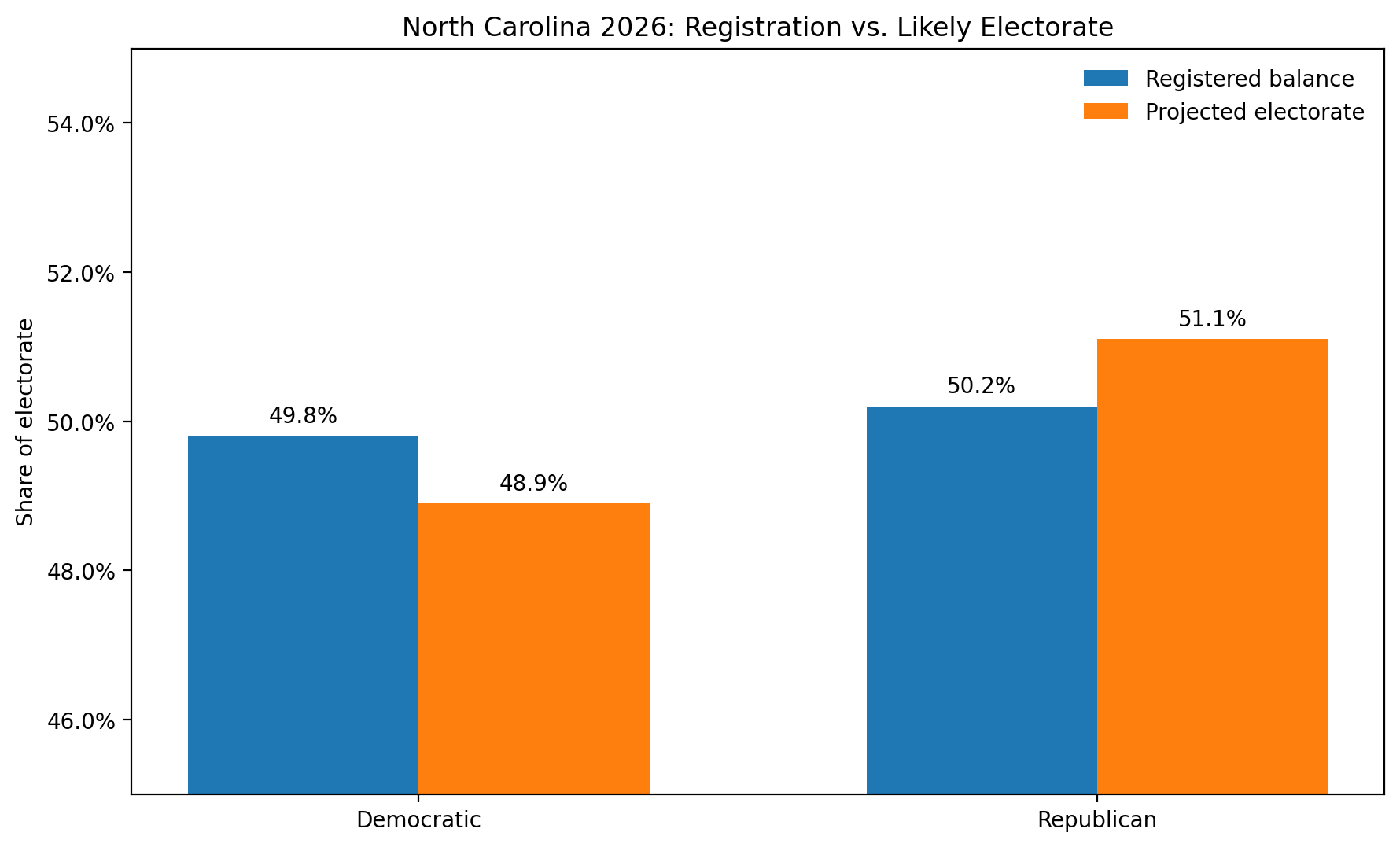
That is the central finding in the data. North Carolina may look evenly matched at the surface level, but the likely 2026 electorate leans Republican. Not by a landslide. Not by some sweeping realignment. But enough to matter. In the model, a registration landscape that appears roughly even becomes a voting electorate that is 51.1 percent Republican and 48.9 percent Democratic.
That 2.2-point difference is small. It is also consequential.
It tells us that North Carolina is not simply a competitive state. It is a competitive state with a Republican-leaning electorate, at least under present turnout conditions. That is a different thing. And it is the kind of difference that decides close races.
The gap is about participation.
Too much analysis of modern elections begins and ends with demographics. North Carolina is changing, we are told, and therefore its politics must be changing in some linear and inevitable way.
But demographic change is only half the story. Sometimes not even half.
The harder question is whether those changing groups vote at the same rate as the older, more rooted, more habitual electorate they are gradually joining. In North Carolina, the answer is no. Not yet.
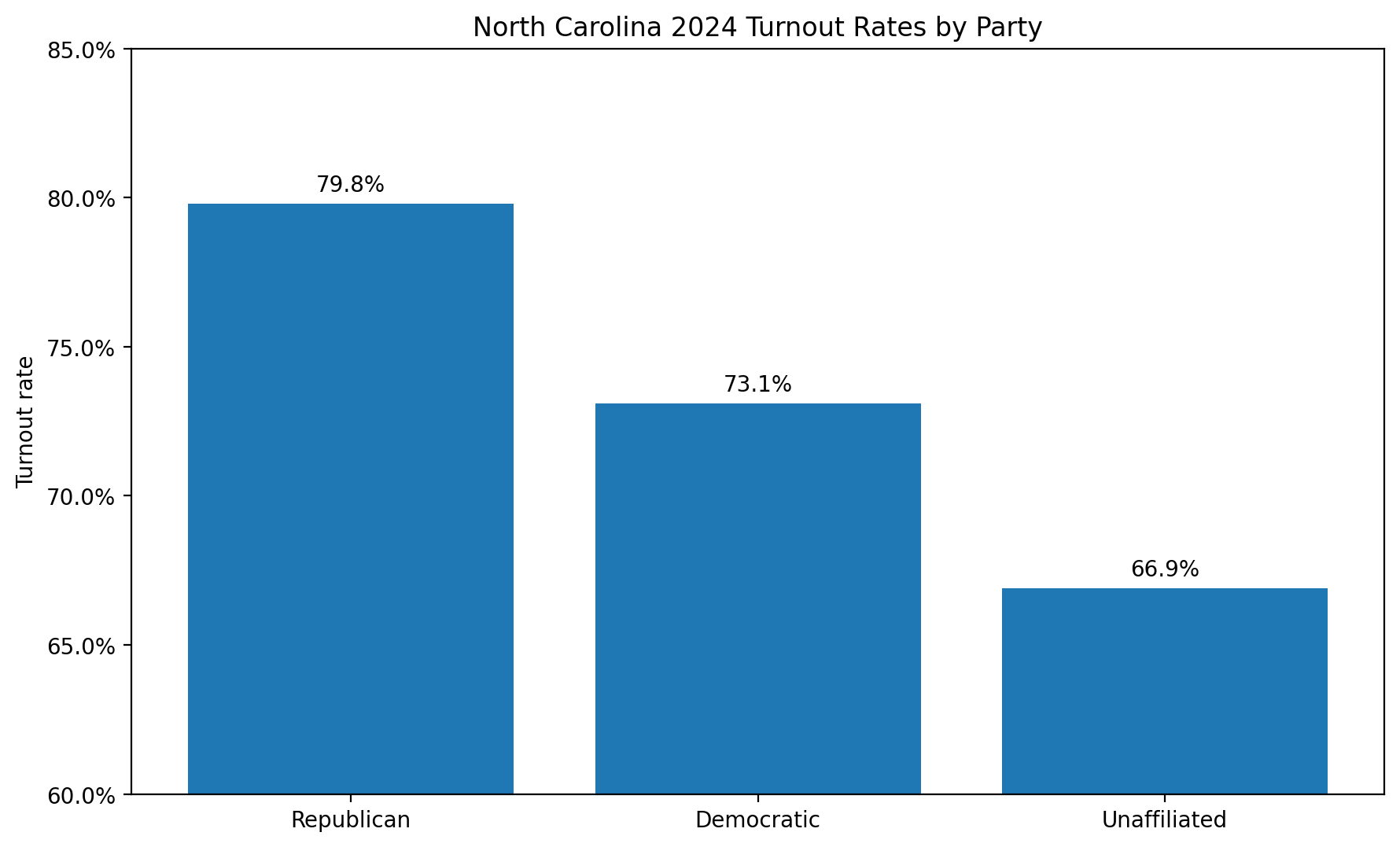
The turnout data makes that plain. In 2024, Republican turnout reached 79.8 percent. Democratic turnout came in at 73.1 percent. Unaffiliated voters trailed further behind at 66.9 percent. The result is straightforward. Republicans are converting more of their potential vote into actual ballots.
That matters more than almost anything else.
A campaign can spend millions trying to persuade a narrow band of swing voters. But if one coalition is already better at showing up, it begins the race with an advantage that no speech can fully erase. Before the ads, before the debates, before the closing argument, the shape of the electorate is already doing part of the work.
That is what the North Carolina data shows. The Republican advantage is not built only on ideology or geography. It is built on voter composition. Their coalition is older, steadier, and more likely to participate.
Age still rules the electorate
There are many ways to describe a state politically. In North Carolina, age remains one of the clearest.
Voters between 18 and 35 are modeled at roughly 57 percent Democratic. Voters 56 and older lean Republican, in the range of 52 to 55 percent. That divide is no mystery. It mirrors broader national patterns. The young lean one way. The old lean another.
But in a midterm cycle, the practical question is not who leans where. It is who votes.
And here the old rule still holds. Older voters are more dependable. They have longer civic habits. They have been registered longer. They are less transient. They are more likely to treat voting as routine rather than occasion.
So while the youngest bloc is one of the most Democratic, it is not the bloc most likely to dominate the electorate. The most Republican age groups remain the most reliable participants. In a state this close, that alone can be decisive.
The model reflects that reality. Years registered accounts for 43.2 percent of turnout-model importance. Age adds another 34.3 percent. Put differently, the strongest predictor of turnout is not what voters say they believe. It is whether they have been part of the civic system for a long time and whether voting has become habit.
That is not glamorous. But it is how elections are won.
Race and growth are real, but so is turnout inequality
North Carolina’s racial composition is changing, and those changes do matter.
Black voters in the model are 76 percent Democratic. Hispanic voters are 63 percent Democratic. Asian voters are 65 percent Democratic. White voters lean 60 percent Republican. Those numbers outline the basic coalitions clearly enough.
Democrats retain their strength among many of the state’s growing communities. Republicans remain strong among white voters, especially those outside the large metropolitan core and among older residents with established voting patterns.
There is nothing especially novel in that. The important point is what follows from it.
A growing Democratic-leaning population does not automatically produce a Democratic electorate. It must first become a voting electorate. That means registration, yes, but also retention, mobilization, and repetition. A new voter who appears once is not yet a habit voter. A demographic trend does not carry political weight until it becomes regular participation.
That is where Democrats still face a structural challenge in North Carolina. Many of the groups that are most favorable to them are also less reliable in off-year participation. Younger voters, newer registrants, and some fast-growing communities may be expanding in number without yet expanding at the same rate in ballots cast.
That is not a moral judgment. It is a mechanical one. The state’s politics are shaped not only by who lives there, but by who votes there regularly.
National shorthand does not always fit this state
One of the useful things about the underlying model is that it resists lazy national storytelling.
Education is a good example. In the national conversation, degree holders are often treated as a uniformly Democratic-leaning bloc. But state politics rarely obey national shorthand so neatly. In this North Carolina model, college and graduate degree holders lean modestly Republican.
That does not disprove national trends. It simply reminds us that state-level coalitions have their own texture. North Carolina has its own social mix, its own suburban patterns, its own business class, its own regional alignments. A state cannot be understood by importing a cable-news template and laying it over the map.
That is especially true in a place like North Carolina, which contains the Research Triangle, fast-growing suburbs, old-line rural counties, military communities, banking interests, retiree regions, Black Belt counties, and mountain conservatism all under one roof.
It is not one state politically. It is several states stitched together. The balance among them is what makes it competitive. The turnout imbalance among them is what makes it lean.
The map may magnify the edge
If statewide competitiveness were the whole story, North Carolina would simply be a recurring coin flip. But district lines matter, and the 2026 congressional map appears to strengthen the Republican position.
The estimate in the memorandum suggests an approximate 11-to-3 Republican tilt. That does not mean every district is in doubt, or that the map alone decides every outcome. It means that modest statewide advantages can be translated into a clearer advantage in seats.
That has become common in modern politics. A state can feel close and still produce lopsided representation. North Carolina is hardly unique in that respect. But the effect here is worth stressing because it reinforces the underlying pattern: a small structural edge, when paired with favorable district design, becomes more than small.
Some districts remain safely where they have long been. The 12th and 4th are strongly Democratic. The 5th, 6th, and 10th are strongly Republican. The real attention falls on the 1st District.
That district is the most revealing test in the state. Earlier framing placed it near even, with a slight Democratic tilt. Under the updated view after redistricting, it remains competitive but leans Republican. That shift is meaningful because the 1st sits at the crossroads of the state’s major forces: racial composition, turnout variation, and the effects of mapmaking.
If Democrats can close the turnout gap there, they are probably making progress more broadly. If they cannot, the Republican structural advantage remains intact.
Counties still tell the truth
There is a tendency in modern political analysis to become overly abstract. Models, projections, coalition shifts, turnout weights. These are useful tools. But politics still happens in places.
The county archetypes in the report help restore that sense of place.
Alleghany and Yancey reflect the durable rural pattern: older populations, high turnout, heavily Republican voting, and deep civic regularity. Chatham represents a different North Carolina: highly educated, high-turnout, near the Triangle, and Democratic-leaning. Pamlico shows how retiree-heavy counties can become turnout engines through age and stability rather than rapid growth.
These counties are not interchangeable. They differ in economy, culture, race, class, and geography. Yet the common thread is participation. They matter because they vote dependably. They shape outcomes not merely by what they believe, but by the consistency with which they act on it.
That is the old truth in democratic politics. The active citizen counts more than the sympathetic nonparticipant.
What the state is, and what it is not
North Carolina is not a locked Republican state. The margins are too narrow for that claim, and the demographic movement is too real. Nor is it a state that Democrats can assume they are destined to win once change runs its course. The turnout structure is too stubborn for that.
It is, instead, a genuinely competitive state with an electorate that still leans to the right.
That distinction matters because it disciplines expectations. It tells Republicans not to mistake advantage for certainty. It tells Democrats not to mistake possibility for arrival. It tells both parties that the state is still in motion, but not in suspension. One side enters with a modest built-in edge because the people most likely to vote remain older, longer registered, and more habitual.
That is not destiny. Candidate quality still matters. So do issues. So does the national mood. Scandals happen. Bad campaigns happen. Strong candidates can outrun weak structures, and weak candidates can waste favorable ones.
But serious analysis begins where the electorate begins.
And in North Carolina, the electorate begins here: with a state that appears evenly divided until turnout is accounted for, and then reveals a small but meaningful Republican advantage rooted in the composition of the people most likely to cast a ballot.
That is the reality of 2026 as the data now presents it.
Not a red state. Not a blue state. A close state, with an electorate that is a little redder than it first appears.