

The Democratic Year—Moderated
Structural conditions favor Democrats, while recent polling suggests a solid advantage rather than a developing wave.

The fundamentals of the 2026 midterm election point toward the Democrats. The polling points in the same direction. But the polls, at least for now, are pointing there with less force.
That distinction matters.
A structural model of the electorate, built from party identification, partisan loyalty and the expected movement of independent voters, places the Democratic generic-ballot advantage near six points. Yet a recency-weighted reading of the national polls places it closer to four. Blend the two, giving greater weight to what voters are saying today, and the estimate settles near Democrats plus five.
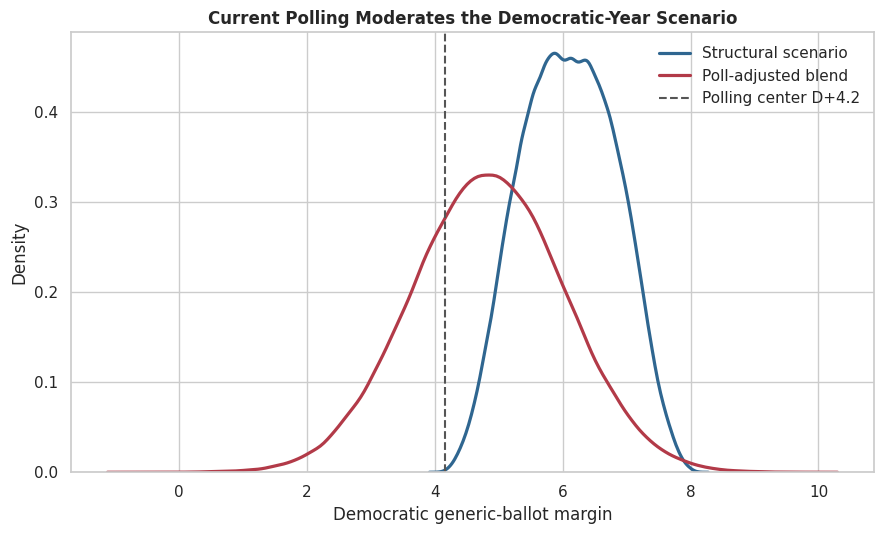
This is still the profile of a Democratic year. It is not yet the profile of a Democratic wave.
The Structural Case
Begin with the electorate itself.
The modeled electorate assumes Democrats make up roughly 35% to 36% of voters, Republicans 33% to 34%, and independents 30% to 32%. The precise shares vary from one simulated electorate to another, but the basic structure remains the same: Democrats possess a modest advantage in party identification, while neither party commands anything close to a majority.
That modest advantage is reinforced by partisan loyalty.
The model assumes that Democrats retain 96% of their identifiers and Republicans retain 95% of theirs. It also allows slightly more Republican crossover toward Democrats than Democratic crossover toward Republicans. These are small differences, but in an electorate divided almost evenly, small differences accumulate.
Still, party identification alone does not generate a six-point Democratic lead. The decisive force is the independent vote.
The model assumes Democrats carry independents by between eight and fifteen points, with a small share choosing another candidate or response. Under those conditions, the Democratic advantage expands from a modest identification edge into a much more substantial national lead.
Across 250,000 simulated electorates, the structural model produces a median result of approximately Democrats plus 6.1. The middle 80% of outcomes falls between roughly D+5.1 and D+7.1. Nearly all outcomes remain Democratic, and more than nine in ten finish at D+5 or better.
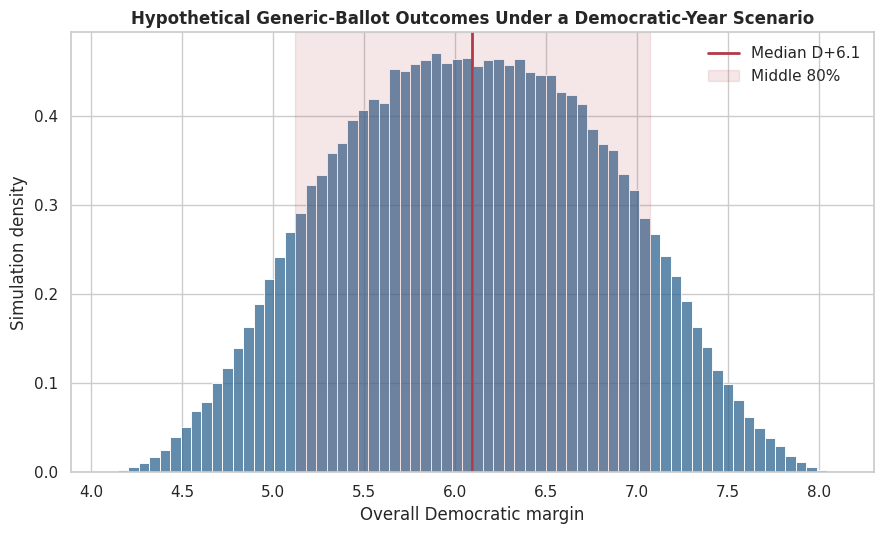
This is not a prediction drawn from a polling average. It is the consequence of a defined political structure: a slight Democratic identification advantage, high partisan consolidation and a substantial Democratic margin among independents.
The model is therefore best understood as a description of what a recognizable Democratic midterm electorate would look like.
The Independent Voter Is the Hinge
Modern elections are often described as contests for the center. That is true, but incomplete. The center matters only after the parties have secured their own ranks.
In the structural model, both parties do so. More than 95% of Democratic and Republican identifiers remain with their side. There is little room for either party to prosper through mass partisan defection.
The election therefore turns on independents.
Among all the assumptions in the model, the Democratic margin with independent voters is by far the strongest driver of the final result. Its correlation with the overall Democratic margin is approximately 0.86. By comparison, the Democratic and Republican shares of the electorate matter less, so long as each remains within the model’s relatively narrow range.
This reveals the underlying arithmetic of the Democratic-year scenario.
A party-identification advantage of two points is useful. It is not sufficient. To reach a national margin near six points, Democrats must also win independents decisively.
That is both the strength and the vulnerability of the structural case.
Should Democrats continue to carry independents by high single digits or low double digits, the model’s center is plausible. Should that advantage contract, the national margin contracts with it. In a closely divided country, there is no surplus vote to waste and no large bloc that can be lost without consequence.
The July Reality Check
Polling introduces a second source of evidence.
The surveys conducted from late May through July differ in sample size, methodology, voter population and frequency. Some poll registered voters. Others poll likely voters. Some are one-time surveys. Others are recurring trackers. Several organizations appear repeatedly, making a simple average vulnerable to over-representation by the most frequent pollsters.
To reduce that distortion, the analysis first averaged each pollster’s results within each month and then compared those pollster-level averages.
The result is difficult to ignore.
In June, the pollster-balanced Democratic margin averaged approximately D+5.9, with a median of D+5.5. In July through July 20, the average had fallen to approximately D+3.4, with a median of D+3.0.
That is an apparent Republican improvement of roughly two and a half points.
It does not mean the political environment has reversed. The July polls in the supplied dataset continued to show Democrats leading the generic ballot. Nor can one month of movement be treated as permanent. Pollster composition changed. Sampling error remains. Likely-voter models are still developing. Temporary events may have influenced respondents.
But the movement is broad enough to merit respect.
The prudent conclusion is not that Republicans have erased the Democratic advantage. They have not. It is that the electorate in July appears less Democratic than it did in June and less Democratic than the strongest version of the structural model assumes.
A recency-weighted estimate, giving greater influence to the newest polls while preventing exceptionally large trackers from dominating the calculation, places the current polling center near D+4.2.
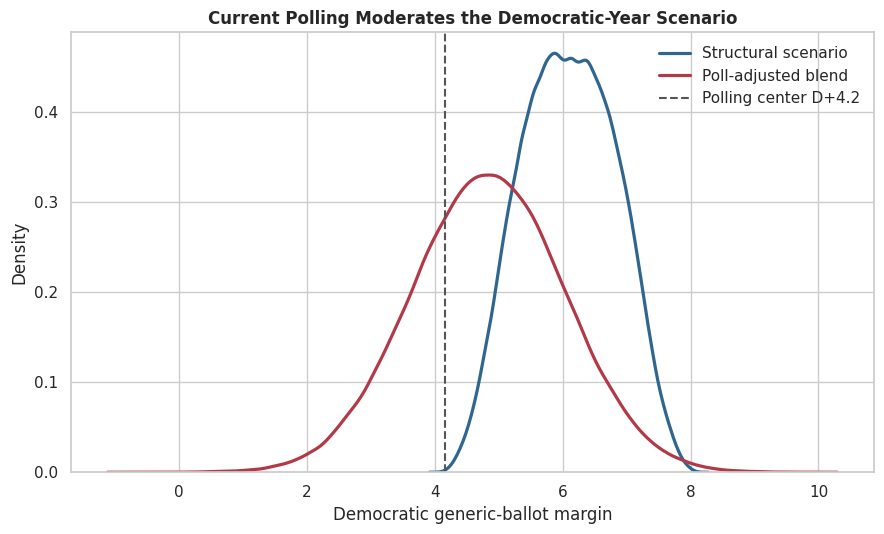
That is nearly two points below the structural estimate.
Polls and Fundamentals
Election analysis often falls into one of two errors.
The first is to treat structural conditions as destiny. A vulnerable president, a favorable party-identification balance or a history of midterm losses becomes proof that the outcome is already settled.
The second is to treat every new poll as a revelation, as though a movement of one or two points has abolished every underlying feature of the electorate.
Neither approach is satisfactory.
Fundamentals describe the terrain. Polls describe where the armies are presently standing.
The structural model says the terrain favors Democrats. It identifies a plausible Democratic electorate in which the party holds a slight identification advantage, remains highly unified and wins independents by a substantial margin.
The polls say Democrats are leading, but not by the full margin implied by that scenario.
To reconcile the two, the blended model assigns 65% of the weight to current polling and 35% to the structural assumptions. This is not a law of political science. It is a judgment about the relative value of present voter sentiment and the underlying composition of the electorate.
The resulting center is approximately Democrats plus 4.8, with a middle 80% interval stretching from about D+3.3 to D+6.4.
The logic is straightforward.
The fundamentals resemble a D+6 environment. The polling resembles a D+4 environment. The blended estimate lands near D+5.
That is the central finding.
The Meaning of Five Points
In ordinary political discussion, the difference between D+4, D+5 and D+6 can appear trivial. It is not.
A two-point change in the national vote can decide a large number of marginal districts. It can determine whether a favorable environment produces a narrow House majority, a durable majority or a result that falls short because Democratic votes are distributed inefficiently.
The generic ballot is not a seat calculator. A national Democratic advantage of five points does not mechanically produce a fixed number of Democratic House seats. Geography, redistricting, incumbency, candidate quality, uncontested races and district-level turnout all intervene.
Even so, the national margin sets the boundaries of the possible.
A result near D+6 would place greater pressure on Republican-held marginal districts and create opportunities beyond the most obvious battlegrounds. A result closer to D+3 or D+4 would produce a more selective battlefield, where district composition and candidate strength become more decisive.
Thus the July movement does not merely alter a chart. It changes the likely character of the election.
The structural model described an electorate approaching wave conditions. The polling-adjusted model describes a clear Democratic advantage, but one that remains competitive enough for campaigns, candidates and turnout to matter.
What the Model Cannot Tell Us
This analysis is conditional.
It does not establish the probability that Democrats will win the national House vote. It does not forecast control of the House. It does not claim that independents will necessarily break for Democrats by eight to fifteen points. Those ranges are assumptions awaiting confirmation from fall polling including our own.
Nor should 39 polls be mistaken for 39 fully independent observations. Recurring pollsters may use the same panels, weighting systems and methodological choices from survey to survey. Their errors may therefore be correlated.
The June-to-July comparison also contains a changing mix of pollsters. A stricter analysis would examine only organizations that fielded surveys in both months. Likewise, likely-voter screens remain uncertain this far from Election Day.
The blended weighting is also judgment-based. A more poll-heavy model would move closer to D+4.2. A more structural model would remain nearer D+6.1.
These are not defects to be concealed. They are the boundaries within which the findings should be understood.
The model does not tell us what must happen. It tells us what follows from the assumptions and evidence available through July 20.
A Democratic Year, Not Yet a Wave
The broad picture remains favorable to Democrats.
They retain an advantage in the national generic ballot. The underlying electoral structure provides a credible path to a margin near six points. The president’s party remains vulnerable, and the most important movable bloc—independent voters—appears inclined toward the opposition.
But July has introduced restraint into the Democratic-year thesis.
The polls have moved closer. Republicans have recovered ground. The current electorate is not behaving as though the full structural case has already been realized.
The distinction is between opportunity and achievement.
The fundamentals describe the opportunity: a Democratic midterm electorate capable of producing a national margin near six points.
The polling describes the achievement so far: a Democratic lead closer to four.
Blend the two, and the most defensible estimate is near five, a meaningful national advantage, a genuine Democratic year, and a political environment that could deliver control of the House.
But a wave is something more. It requires the favorable structure to be converted into actual votes, especially among independents, and sustained through the formation of the likely electorate.
That has not yet happened.
The country is leaning Democratic. It is not, at present, breaking Democratic.