

When Do Midterm Polls Start to Tell the Truth?
A look at 2014, 2018, and 2022 suggests August can reveal the political environment, but mid-October is a much better guide to the final national House vote.

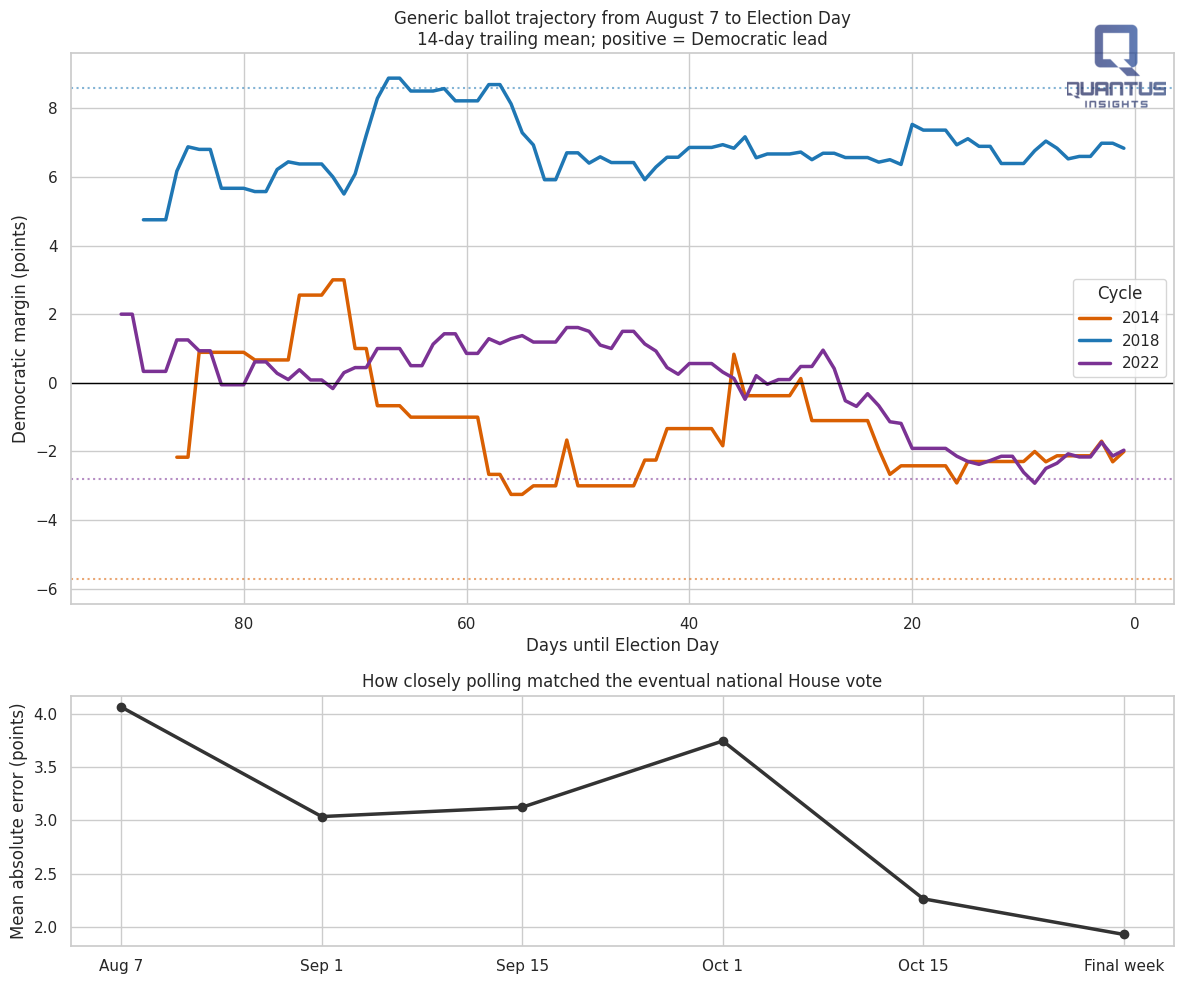
Political polling in August can tell us something important about the kind of midterm election taking shape. What it usually cannot do, at least based on the 2014, 2018, and 2022 elections, is tell us exactly where the national House vote will end up.
Across these three cycles, August polling generally captured the broad environment and a large and persistent advantage mattered. Conversely, a narrow lead was far less dependable. Close margins shifted, crossed from one party to the other, and noise became the signal obfuscating where the electorate would eventually land.
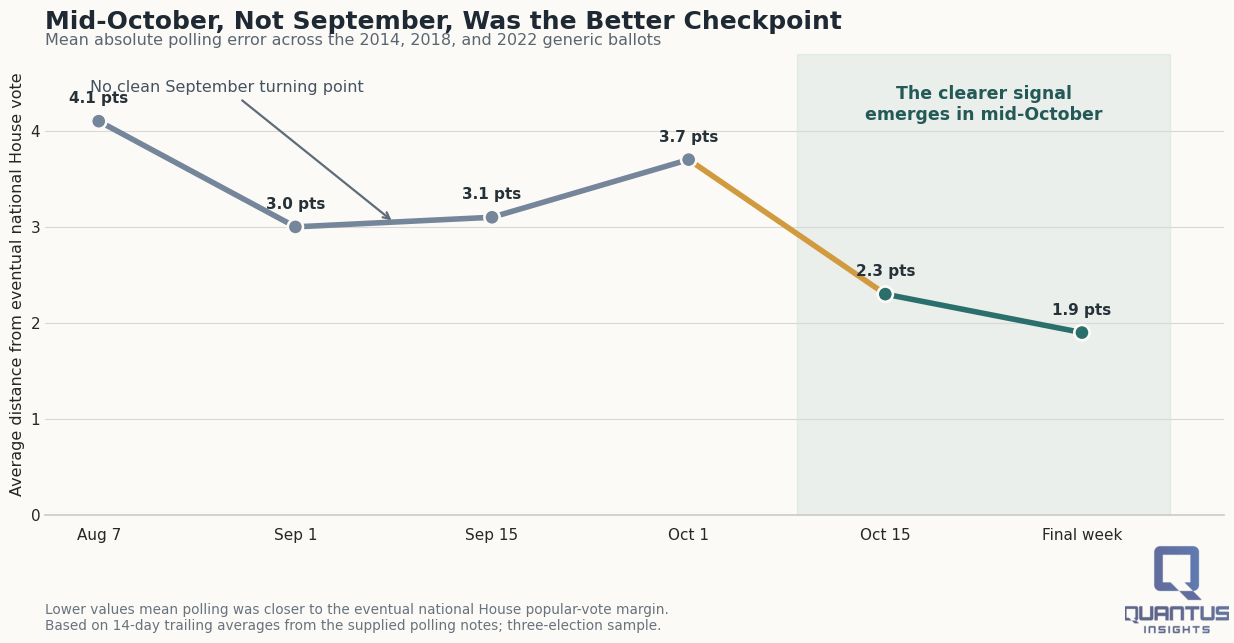
September polling is little better. Improvement did not appear at a particular point in that month either. Instead, the more useful checkpoint was around mid-October, roughly three weeks before Election Day.
In 2022, August polling gave Democrats a modest advantage that ultimately disappeared. Around August 7, Democrats led the generic ballot by roughly two points. Republicans eventually won the national House popular vote by about 2.8 points.
For much of August and September, the Democratic lead remained small but often enough to create a noticeable trend. By around October 1, the average had moved close to even. During October, however, it shifted toward Republicans, and by the final week Republicans led by roughly 2.3 points, close to the eventual result.
That makes 2022 the clearest warning against treating an August lead as a forecast of November. In this case, meaningful movement occurred in October.
The story was very different in 2018. Democrats already held a substantial advantage in August, and the basic picture never seriously changed. Around August 7, they led by about 4.8 points. By September 1, the lead had grown to nearly nine points. It later narrowed, but Democrats remained comfortably and clearly ahead in the generic ballot.
In the final week, Democrats led by roughly 6.8 points. They ultimately won the national House popular vote by about 8.6 points. While the aggregates moved the central story of that cycle remained stable: Democrats were headed toward a clear national victory. A large and persistent lead that fluctuates is very different from a two-point lead that later disappears or flattens into a true statistical toss up.
If we look further back, the 2014 cycle fell somewhere between those cases. Republicans held an advantage of roughly two points around August 7, but the polling was much noisier during that cycle. By mid-September, their lead had grown to about three points, only for the average to briefly move toward Democrats around the beginning of October.
That interruption did not last as momentum swung toward Republicans. By mid-October, Republicans were ahead by roughly 2.7 points, and the final-week average showed them ahead by about 2.1 points. Polling failed to capture the true Republican-leaning electorate, and the party ultimately won the national House vote by approximately 5.7 points.
So the polling broadly identified the Republican direction of the election, but understated the eventual margin. It also produced a misleading Democratic-looking signal in early October.
Taken together, the three elections suggest there is no simple rule that polls remain stable or steadily move toward whichever party is already leading. When one party holds a large and persistent advantage, as Democrats did in 2018, the lead tends to survive ordinary fluctuations. On the other hand, when the generic ballot is within roughly three points (which is to say, a standard polling error), however, August and September offer much less certainty.
Interestingly, polls don’t necessarily move toward the party that was ahead in August. In 2022, for example, Democrats began with the advantage, but the late movement favored Republicans. The campaign environment can change and pollsters can change their likely voter models, and polling can change as a result.
Most importantly, however, the timing of polling accuracy also matters. Across these elections, average absolute error was about 4.1 points in early August. It improved to roughly 3.0 points around September 1, remained near 3.1 points in mid-September, and worsened to about 3.7 points around October 1.
The clearer improvement came later. By around October 15, average error had fallen to approximately 2.3 points. In the final week, it declined further to about 1.9 points.
None of this is to say that polls before mid-October are useless. They can be predictive of the election’s direction even when they are not yet precise about its final margin. Until some better instrument for measuring public sentiment emerges, polling remains the best tool available. Its value, however, depends heavily on the size and durability of the lead. A sustained advantage of six points or more is meaningful even in August. That framework has immediate relevance in 2026. As of August 11, Democrats hold a national generic-ballot advantage of roughly six to seven points and held a four-point lead at the comparable point in 2025.
While the eventual margin remains uncertain, and October could still alter the picture, the recent historical evidence suggests that a lead this large and persistent should be treated as a meaningful indication of the election’s direction, even if it is not yet a precise forecast of the final vote. A three-to-five-point lead suggests an advantage but not a settled outcome. A lead below three points is better treated as competitive until deeper into October.
The most useful question, then, is not simply: Who is ahead today? It is: How large is the lead, how consistently does it appear across pollsters, and is it still there by mid-October?
The history of 2014, 2018, and 2022 suggests August is best understood as a picture of the political environment, not a precise forecast of Election Day. September adds information, but these elections do not reveal a dependable September turning point. Close races can still move substantially in October, while larger leads tend to hold at scale.
The sample for this study is small, of course, and polling coverage was uneven, especially in 2014. These examples should therefore be treated as a useful historical pattern rather than a universal rule.
Still, the pattern is practical: August can tell us what kind of election may be developing. Mid-October is when we can become much more confident about where it is actually going.
If there is any consistent pattern from August polling through October it’s that the party in the White House never sees its fortunes improve. That’s been the case in midterms going back decades. At best, their fortunes stay the same. Otherwise the bottom falls out. 2010 is a great example of the latter. Republicans were ahead in the polls in August but it wasn’t until October when their lead exploded.